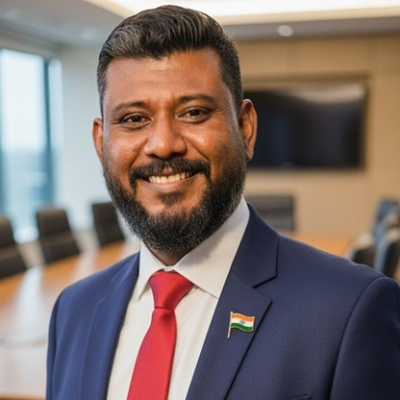
Balaji Iyer is the India Managing Principal at Baker Tilly One India, where he oversees the strategic and operational leadership, including the establishment and growth of the firm’s India capability center. With two decades of experience in the professional services industry, Balaji has extensive experience in designing and executing GCC strategies and new service incubations for both large and mid-sized accounting firms. Proficient in delivering long-term results, his expertise includes applying Digital Transformation, Experience Design, Knowledge Management, Design Thinking and Systems Thinking approaches to solve business problems and driving enterprise transformation, digital-first initiatives and new ways of global teaming. In addition to his professional work, Balaji is involved in thought leadership and public speaking, focusing on topics such as culture, the future of work, innovation, and employee experience. He is a member of the CII Knowledge Core Committee and KM Global Network.
For mid-market organizations, transformation is no longer a destination — it is a continuous journey requiring deliberate operational design. Margin pressure, talent scarcity, regulatory complexity, and persistent microeconomic disruption have increased the demands on finance, HR, and IT. Traditional operating models are increasingly misaligned with today’s operational realities, and execution risk is rising.
This workshop captures how mid-market leaders are creating durable operational advantages. Participants will explore how organizations can rethink how work gets done, where decisions sit, and how execution is sustained, moving beyond isolated initiatives to build integrated operating models that absorb volatility while maintaining performance.
Workshop Focus
The session will address key themes introduced in the report, including:
• The pressure is structural, not cyclical: Mid-market leaders face persistent structural pressures that make operational advantage — the ability to maintain speed, control, and reliability under sustained complexity — the key measure of performance.
• Leaders are pulling multiple levers at the same time: Midmarket leaders are simultaneously pulling multiple levers to drive growth, efficiency, and resilience, making the ability to coordinate execution through a consistent, accountable operating model the key to sustained performance.
• Talent is no longer an HR issue it is an operating constraint: Talent is a critical operating constraint, and operational advantage depends on embedding institutional knowledge and execution experience into resilient operating models rather than relying on individual employees.
• AI investment is accelerating but execution remains the gap: AI investment alone is insufficient—operational advantage depends on embedding AI into structured operating models where governance, accountability, and execution are clearly defined.
• The real reframe - Operational advantage as a strategic tool: Operational advantage is the true measure of transformation, enabling organizations to sustain performance, absorb change, and maintain confidence amid continuous pressure and complexity.
Key Takeaways
• Operational advantage is the new performance metric – Success is measured not by transformation initiatives or technology adoption alone, but by an organization’s ability to sustain speed, control, and reliability under ongoing structural pressures.
• Execution, not effort, drives results – Pulling multiple levers (growth, efficiency, talent, AI) only creates value when coordinated through a consistent, accountable operating model that embeds experience, knowledge, and governance.
• Technology and talent are amplifiers, not solutions – AI and workforce investments deliver impact only when integrated into operating models that reinforce judgment, process discipline, and operational resilience.
Check out the incredible speaker line-up to see who will be joining Balaji.
Download The Latest Agenda