Combining AI and Human Insight to Strengthen Continuous Financial Recovery
Add bookmark

Organizations have spent years investing in Procure-to-Pay (P2P) automation, analytics, and controls. Artificial intelligence (AI) adds another layer, analyzing large volumes of information to identify patterns and surface anomalies that traditional review may miss. In financial recovery, that can be significant.
But it raises an important question.
What happens after AI finds the leakage?
The answer requires looking at financial recovery differently. The recovered dollar matters, but the finding itself may be the more valuable asset. It can reveal how and why leakage occurred, and where the underlying process may need to change.
Identifying potential leakage is only the beginning. The real value comes from connecting that insight to recovery, understanding why the leakage occurred, and improving the underlying process. The future of financial recovery is about combining the speed, reach, and pattern-recognition capabilities of AI with the context, judgment, and organizational knowledge that people bring to the process.
From Recovery to Continuous Improvement
Financial recovery is often measured by dollars recovered. Those dollars matter, but a recovery finding can provide something even more valuable: insight into how the organization actually operates. Consider a recurring pricing discrepancy with a supplier. The immediate question is whether the money can be recovered, but the more useful question is why the discrepancy occurred in the first place. Was the negotiated price never updated in the purchasing system, or updated too late? Was the purchase order created with an outdated price, or was the supplier's invoice simply wrong? And just as important, is this an isolated error or a sign of something systemic? Those questions move the discussion beyond recovery and toward process improvement, creating a continuous cycle.
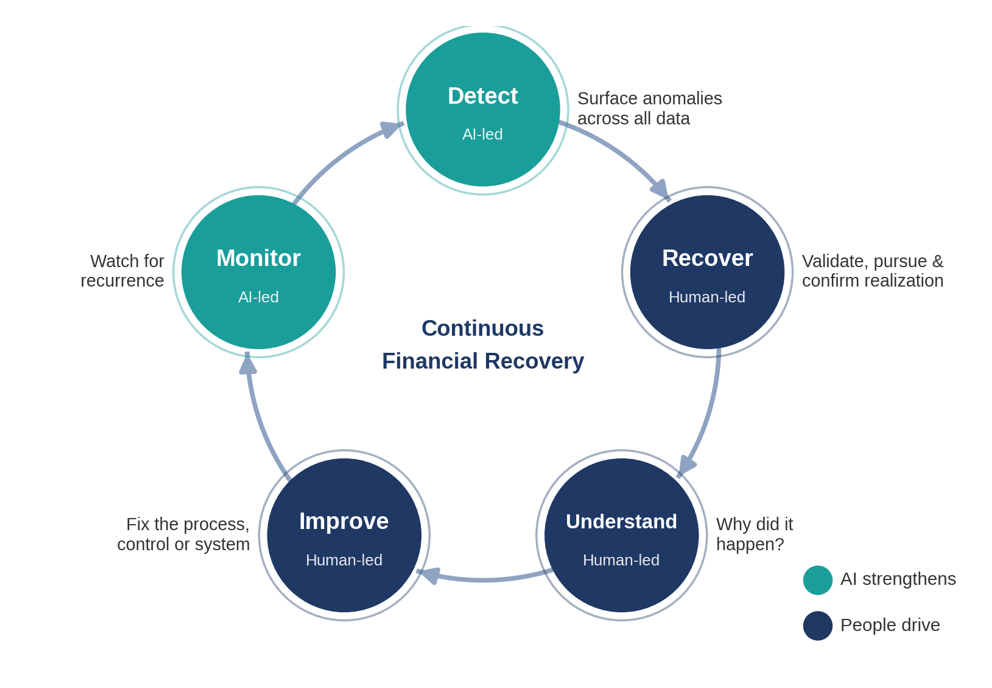
AI can significantly strengthen the Detect and Monitor stages. But Recover, Understand, and Improve still require context, judgment, collaboration, and organizational ownership. That is where the lasting value is created.
AI-Powered Financial Recovery
AI can also expand the scope of financial recovery analysis, identifying recurring pricing or unit-cost variances, unusual payment patterns, supplier-specific anomalies, unresolved credits, and other issues that traditional rules-based reports were never designed to detect.
A Duplicate Traditional Reports Miss
In one review, AI identified a duplicate payment where the two invoices had completely different invoice numbers and invoice dates, the very fields most traditional duplicate payment reports rely on. What gave it away was the line description: both invoices described the same service for the same service month. Most traditional duplicate payment reports don't go that deep.
Even so, the flag was a starting point, not a conclusion. Someone still had to validate the duplicate, recover the funds, and determine why two invoices for the identical service period were submitted, and whether the underlying process could allow it to happen again.
AI can identify a pattern. People must understand the business context behind the pattern.
There is also value in looking beyond a single system. The ERP shows what the organization recorded, while a supplier statement of account (SOA) shows the same relationship from the supplier's side. Neither tells the whole story by itself, but each adds visibility the other lacks. AI can assist by comparing and classifying information across both sources, giving people a broader view of the transaction and the relationship behind it. People can spend less time searching through data and more time applying business context, validating exceptions, and deciding what action is appropriate. That combination produces the best results.
The Human Process Still Matters
AI can generate hypotheses, and often very good ones. But a hypothesis still must be tested. If AI flags an unusual number of pricing variances with a supplier, a person still needs to determine why. The supplier may have made an error, a negotiated price may not have reached AP, or there may be a legitimate explanation. The transaction data alone may not provide the answer. Getting there may require reviewing payment history, contracts, emails, or pricing agreements that never made it into the system, as well as talking with people in other departments and at the supplier.
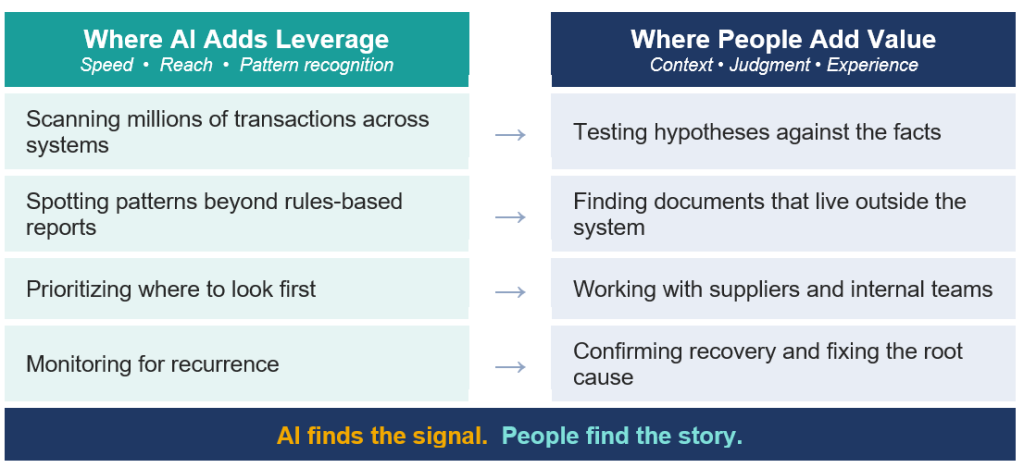
Validation doesn't end when a supplier agrees an overpayment occurred, either. A recovery isn't complete until the credit has been fully deducted on a future payment or refunded by the supplier, and that has been confirmed. An acknowledged credit that is never applied is simply leakage by another name. This is why the human element remains central. The people closest to Procurement, AP, Shared Services, Finance, and suppliers bring the context, experience, and institutional knowledge needed to turn a data point into an actionable insight.
Turning Recovery into Organizational Intelligence
A mature approach to financial recovery doesn't stop when value is recovered. It uses the findings to identify patterns, understand root causes, and improve processes. That might mean changing a system configuration, strengthening a control, addressing a supplier issue, improving a workflow, or clarifying ownership. A recurring credit issue may reveal a supplier-management problem, while a pricing discrepancy may point to a purchasing or system timing issue.
The opportunity for P2P and Shared Services organizations is to treat financial recovery as an ongoing source of insight rather than simply a mechanism for finding dollars. Recovery can evolve from a process focused on finding and recapturing value into one that generates insight, drives action, and continuously improves the organization.
The cycle becomes:
Transaction → Insight → Action → Improvement → Monitoring.
AI can make that cycle broader and faster.
People make it meaningful.
The ultimate measure of success isn't how much leakage is recovered. It's how much the organization learns from that leakage, and how effectively that knowledge is used to prevent the same problems from recurring.
Image Attribution
Image #1 - Image created by Rachel GuttenbergImage #2 - Image created by Rachel Guttenberg
Image #3 - Image created by Rachel Guttenberg
Image #4 - ©[nugrohoiif from Nugroho iif] via Canva.com