
Fourteen editions in, ●Connecting●The●Dots● has covered a lot of ground. Not theoretical ground — ground built from my own career, fifteen roles across twenty-one years, connecting the dots as I went rather than following a straight line. We've talked about the Intelligence Triad, the Virtuoso Dynamic Model, Data Hedges, the White Canvas, the Perfect Process. Frameworks for what GBS 3.0 needs to look like.
But there's a question none of those editions answered: who actually moves it from the slide to the shop floor?
Because here's the uncomfortable truth. Strategy on paper is comfortable. Vision decks are easy. What's rare — genuinely rare — is the Leader who can take a strategy built on conviction rather than certainty, and carry it into execution anyway.
That's the skill everyone wants to buy through a training course, and the one that simply can't be bought. It comes down to two very natural things: the gifts we're given, and the opportunities we choose to take to put these gifts into practice — boldly, without hesitation, and rooted mostly in conviction rather than Data. Because when we transform, we are usually walking into uncharted territory. Data is rarely available where we're going, and assumptions aren't worth very much when the ground hasn't been mapped yet. It's precisely in that space of uncertainty that true Leadership instinct shows itself — or doesn't.
A Laboratory Called "My Own Life"
I didn't learn this from a Leadership textbook. I learned it from being uprooted, repeatedly, and having to adapt.
Born and raised in South Africa through the 1980s and early 1990s, then my teenage years in Portugal, then the last fifteen years living and working across different European countries — this has been my own laboratory for understanding human behaviours and cultural agility. Testing, learning, making mistakes, and slowly refining what I'd now call my own Leadership agility: the capacity to adjust and adapt across very different environments, at work and in life, while remaining true to my own values and belief system. In the process, I've been lucky enough and privileged to be able to grow people, and in the process also growing myself, while trying to become — in the language of the Leadership Pipeline [1] — a Leader of Leaders, the ultimate stage that we build progressively over time and through experience.
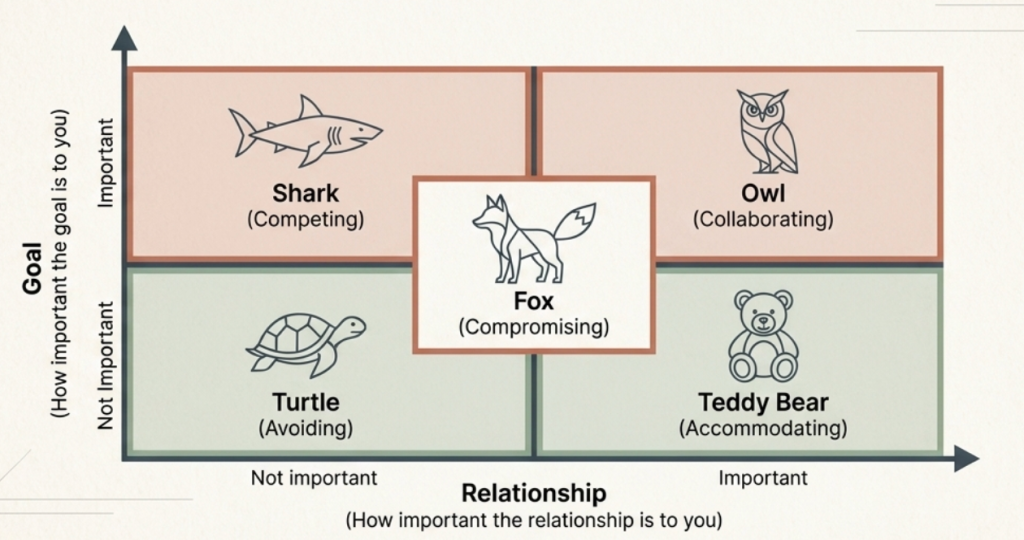
Somewhere in that personal laboratory, I came across a simple, almost disarmingly easy-to-understand matrix: the Thomas-Kilmann model, developed by Kenneth W. Thomas and Ralph H. Kilmann, which uses five animals to describe behaviour [2]. I first encountered it at a men's retreat at my home church, of all places — not in a Leadership programme, not in an MBA. And it has stayed with me, and resonated more and more, in the time since then.
I should be honest about one thing: Thomas and Kilmann built this matrix to explain conflict management, not leadership under transformation. What follows is my own extrapolation of their theory — applying it to how Leaders behave when they're trying to move Strategy into Execution. I think it holds up. Let me show you why.
The Matrix Behind the Animals
Strip away the animals for a moment and the model rests on two simple questions, playing out on two axes: how much do you care about the goal, and how much do you care about the relationship? Everything else — every behaviour, every animal — is a position on that grid.
That reframing matters more than it first appears. Most of us instinctively treat conflict as a contest to be won or a mess to be avoided. The goal-versus-relationship lens forces a more honest question: in this particular transformation moment, which one actually matters more — and am I choosing my response deliberately, or defaulting to the animal I always am?
None of the five positions is inherently wrong. Each has situations where it is genuinely the right call. The danger isn't behaving like a shark or a turtle occasionally — it's getting stuck there permanently, unable to recognise when the moment calls for something else.
The Five Animals
In companies, just as in GBS organisations, People will behave — under pressure, under ambiguity, under conflicting agendas — remarkably like animals. No negative connotation intended. At our core, we are animals too.
The Shark. No real intention to collaborate, no interest in building community. The shark cares about the goal, full stop, and will sacrifice the relationship to get there — using authority, pressure, or plain intimidation if that's what it takes. There are moments this is the right call: a genuine emergency, a decision that cannot wait, a situation where you are the one being treated unjustly and holding your ground is the only option. The failure mode is the leader who reaches for the shark by default, in every negotiation, and burns the very stakeholders whose belief the transformation depends on.
The Turtle. Happiest when left alone. Cares about neither the goal nor the relationship enough to engage, and will often withdraw into its shell rather than face the conflict — sometimes giving up the goal entirely, sometimes quietly ending the relationship instead. Avoidance can be the right instinct: when the issue genuinely isn't worth the fight, when confronting it won't change anything, or when it's wiser to let things cool before engaging. The failure mode is the leader who avoids the White Canvas conversation indefinitely, mistaking delay for patience.
The Fox. The master of compromise. Moderately concerned about both the goal and the relationship, and willing to trade away part of one to protect some of the other — meeting in the middle so everyone leaves with something. This is often the pragmatic choice when time is short or when a long history of mistrust means a bigger ambition simply isn't achievable yet. The failure mode is treating compromise as the default answer to every transformation decision, when what was actually needed was the harder, fuller solution.
The Teddy Bear. Not the most obvious animal choice — I suspect the original authors simply couldn't find anything better — but the meaning is clear. The teddy bear values the relationship over the goal, and when forced to choose, will set the goal aside to protect the relationship or support the other person. There are moments this is exactly right: when the issue matters more to the other person than to you, when someone genuinely needs care rather than confrontation. The failure mode, and it's a common one in transformation, is the leader who is easily manipulated because avoiding conflict has become more important than the outcome itself.
The Owl. The one animal the other four respect. The owl cares about the goal and the relationship in equal measure, treats conflict as a problem to be solved rather than a contest to be won, and looks for the path that leaves the outcome and the relationship both stronger. It is, deliberately, the harder and slower style — it demands that everyone's commitment be genuinely won, not assumed. But it is the only one of the five built for exactly what a White Canvas transformation requires: outcomes that depend on people actually believing in them. And unlike the other four, which tend to come naturally, being an owl consistently is something learned through practice, not a personality trait you either have or don't.
Where Do You Sit — and Where Do Your Stakeholders Sit?
None of us is purely one animal. The honest truth is that most of us move around this matrix depending on the situation and the stakes. We're the shark in one negotiation, the turtle in a meeting we'd rather not be in, the fox when a compromise genuinely serves everyone, the teddy bear when we care more about the relationship than the outcome.
But when transformation is on the line — when a Process or Operating Model needs to be redesigned from a White Canvas, when a sponsor needs to hold their nerve through eighteen months of ambiguity — it is the owl, consistently, who makes it land.
So the questions worth sitting with are these: Where do you naturally position yourself on this matrix? And just as importantly — where do you position the People around you? Your sponsors. Your Process Owners. The stakeholder who keeps quietly stalling the redesign. The peer who keeps trading away scope to avoid a difficult conversation.
You cannot lead a transformation without first knowing which animals are actually in the room.
How This Plays Out in GBS 3.0
Take the White Canvas moment — the point where a GBS or SSC leader has to decide whether to redesign a Process from the outcome backwards, rather than automate what already exists.
The shark forces the redesign through by mandate, without bringing Process Owners along — and inherits a workforce that complies without believing, which quietly kills adoption six months later.
The turtle avoids the conversation altogether. Reengineering threatens headcount, threatens comfort, threatens the org chart as it stands — so the White Canvas moment simply never happens, and the organisation keeps agentifying the cow paths instead.
The fox negotiates the redesign down to something everyone can live with — a Perfect Process diluted into a merely adequate one, because compromise, applied to a genuine transformation, produces mediocrity dressed up as consensus.
The teddy bear protects every relationship in the room, defers to whoever pushes back hardest, and ends up with a Process that preserves the past to avoid discomfort in the present.
The owl does the harder thing. It brings the Process Owners and Data Stewards into the room early, holds the line on the outcome without steamrolling the People who have to deliver it, and is willing to sit inside real disagreement long enough for a genuine White Canvas design to emerge — not a quick win, not a forced mandate, not a watered-down compromise.
The same pattern plays out in a Data governance dispute over who owns Master Data across functions, in a GBS Condominium negotiation over which capabilities get mutualised and which stay proprietary, in a supplier onboarding redesign where turnaround targets collide with a risk team's instinct to slow everything down. Different rooms, same five animals, same outcome: only the owl actually gets the transformation to the other side.
This is, in the end, what the Intelligence Triad has been pointing to all along. AI can synthesise. Process can be redesigned. But the Orchestration layer is human — and it takes an owl to orchestrate it well.
The Question I'll Leave You With
Which animal shows up when your transformation timeline collides with someone else's turf?
And a harder one: which animal(s) reflect your key stakeholder(s) ? Knowing this can help position your transformation agenda accordingly.