Data Governance: From Oversight to Orchestration
How enterprises build trust by balancing compliance, accountability, and flow
Add bookmark

Credentials and Credibility: A Governance Dilemma
Becoming a Black Belt was a big deal for me back in 2011. At the time, Lean Six Sigma certifications felt like the ultimate proof of expertise, and a project would take a year to complete. Results would be scrutinized by a board of Master Black Belts, and certification meant you had truly walked the walk.
Or so I thought. One day, a senior manager in my company proudly announced her new Black Belt. I congratulated her, then casually asked my mentor, a towering South African with a booming voice and unmistakable accent, which project she had led. His answer floored me: “She self-certified.”
That wasn’t an isolated case. I discovered this shortcut existed across industries, not just in tech or manufacturing but also in banking and finance. What I saw was troubling: acronyms piling up at the end of people’s signatures, yet little accountability behind them.
This is where governance matters. It’s not about collecting titles or certifications but ensuring transparency, accountability, and verification. In data terms, governance ensures that information is consistent, auditable, and compliant across functions, systems, and borders.
Blink, Bias, and the Human Side of Decisions
Not long after, I came across Malcolm Gladwell’s work on sifting analysis, leading to fast action. At first, it felt like science fiction: snap judgments buried deep in the subconscious guiding decisions. But in hindsight, it mirrored something I was about to witness.
As a financial analyst, I lived this tension daily. Responsibilities, expenses, and pressures doubled overnight with family life. So I doubled down with training, projects, and certifications, hoping for promotions. Data alone rarely hands you a perfect answer; there’s a way each of us can govern our own judgments, priorities, and, in the enterprise, your compliance structures, which determine which data points matter when time is short.
Mentors, Oversight, and Organizational Governance
At Hewlett-Packard, I had the immense good fortune of working with mentors from around the world. Whenever visitors came through our service center in Poland, I treated those conversations as data sampling. That was not structured data; it was qualitative data with insights into how they saw our processes, our people, our industry.
Some of those mentors were humble leaders who balanced technical expertise with openness and led by example. Analyzing their thoughts and ideas showed me that true governance is less about rigid control and more about building systems where accountability, compliance, and trust can live side by side.
For enterprises today, governance has expanded. It now covers regulatory compliance (GDPR, HIPAA, data sovereignty), data stewardship, cross-border portability, and access management. Without those safeguards, it is obvious that even accurate data loses credibility.
When Data Demands Action
In 2012, after submitting my Black Belt project to a panel and earning a golden plaque, I made a difficult choice to leave Hewlett-Packard and seek my next challenge. Rational analysis might have told me to stay; the company was nearly stable, the path was predictable. But the governance of my own life, where family would always come first, led me to keep values intact and do what I thought was right.
The year was 2022, when Serena Williams told the world, “I just need to stop.” She reframed her career not as a pivot toward family and personal growth. For organizations, governance provides that same anchor telling when to act, when to pause, and how to align decisions with broader values and compliance obligations, towards regulators and stakeholders, customers and employees.
From Supervising to Orchestrating Data
Supervision was once the default mode of governance; it focused relentlessly on control with accurate enforcement, compliance checking, and identifying anomalies to be flagged. That worked just fine in an era of limited, structured data, and the approach was effective. Today, much of this is automated with machines able to supervise data with greater speed and precision than human oversight ever could.
Historically, Management marked the next stage, which shifted governance toward execution. The coordination of teams and their inputs, allocating resources, and ensuring delivery of outputs, checking Dashboards, KPIs, and performance frameworks worked well in this mode. In data terms, management meant structuring flows so that decisions could be made on time, having technology being absorbed with predictive analytics and automation to guide decisions that managers once made manually.
Data Orchestration is different, not about controlling or delivering but about creating flow across fragmented ecosystems. That's a new trend that harmonizes conflicting definitions, integrates siloed processes, and ensures that governance extends beyond compliance into the organization’s purpose. Once supervision has been enforced, data and management are delivered. Now, orchestration unifies all those bits and pieces.
This matters a lot in the current context because Data quality alone can’t guarantee it can be trusted. To give an example, a certain Country can collect reliable employment data, but another can categorize ‘self-employed’ under separate rules. Without orchestration, these inconsistencies would remain invisible until they undermine outcomes of, let’s say, an economic area like healthcare costs, where insurers and hospitals categorize treatments differently. With orchestration, governance ensures not only accuracy within silos but coherence across the whole system.
Governance as the Conductor in an Orchestra
All these stories point to the fact that governance is not bureaucracy, and if we talk about orchestration, that’s more like the conductor in an orchestra. Certifications without oversight can only erode credibility, decisions without context misfire, and organizational cultures that dismiss unstructured data miss vital signals.
Enterprise data governance must now evolve from static compliance to dynamic orchestration. That means building systems where Supervision is embedded into technology, providing guardrails that keep every section on the right pace and rhythm.
Management is supported by predictive analytics, ensuring instruments are tuned and ready before the performance, and Orchestration integrates people, processes, and AI into coherence, so the enterprise actually plays the same tune.
This shift reframes governance from a defensive measure into a strategic asset, which does not replace supervision or management with orchestration. That rather brings them into harmony, ensuring that when action is needed, Data will not only be trusted but understood, and people will understand how to act.
For executives, the action is rather obvious; governance can no longer be treated as a compliance checklist, but as a way how create the architecture of their enterprise and make it resilient. In a world where AI amplifies both opportunities and risks, orchestration ensures data is more than just correct in a technical way but aligned with their strategies and values. This is what turns scattered signals into decisions that scale, enabling GBS transitions to succeed, AI to remain trustworthy, and organizations to adapt under pressure. The enterprises that will survive and thrive will be those that treat governance as a conductor treats an orchestra with precise alignment and purpose, so that performance is not only efficient but meaningful.
As W. Edwards Deming said, “Without data, you’re just another person with an opinion.” In the age of AI and transformation, we might add that without orchestration, you’re another enterprise with instruments but no music to play.
Continue your Process Excellence journey...
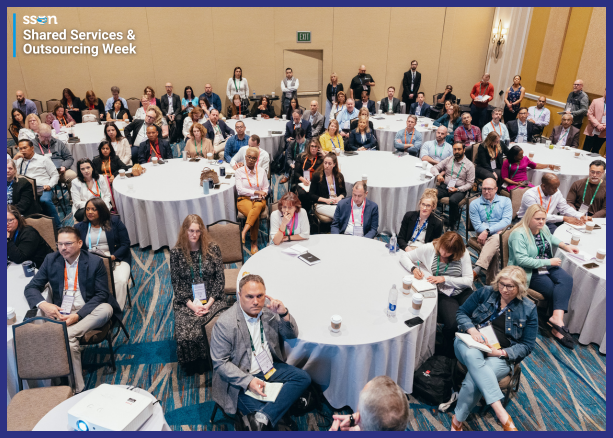
Transformation depends on the strength of your processes. Join the Process Excellence Program at the 30th Annual Shared Services & Outsourcing Week conference (March 16–19, 2026, Orlando, FL) to see how top SSOs are turning standardization and analytics into strategic advantage.
Learn More