How Can Companies Scale Enterprise AI from Pilots to Business Value?
Add bookmark

Companies scale enterprise AI by linking each use case to a measurable business outcome, improving the end-to-end process, building reusable foundations, applying clear governance, and preparing people for new ways of working.
Key Takeaways
- Start with a business outcome, not an AI tool.
- Redesign end-to-end processes instead of automating isolated tasks.
- Use shared data, platforms, and governance to scale faster.
- Measure value with a baseline, owner, and practical success metrics.
- Involve employees early, so adoption and skills grow with the technology.
Most companies are not short on AI ideas. They may have dozens of use cases and promising pilots, but far fewer have changed how the enterprise operates or delivers value at scale. The opportunity now is to move from experimentation to mobilization by connecting people, processes, data, and technology around outcomes that matter.
Scaling Enterprise AI: What It Means
Enterprise AI means using artificial intelligence (AI) across an organization to improve decisions, services, and workflows. Scaling enterprise AI means moving beyond a limited test and making an AI-enabled capability reliable, governed and reusable in everyday operations.
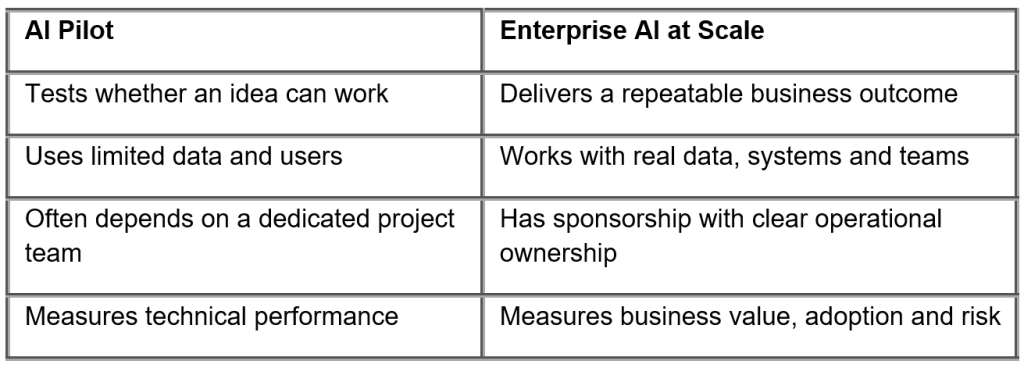
AI does not create value on its own. Value comes from improving how work gets done. Leaders should first identify where customers, suppliers, or employees experience friction, where decisions are delayed, and where handoffs break down. They can then decide where AI, automation, and data will produce a better result.
This approach is called horizontal AI: applying AI across an end-to-end process rather than optimizing one task inside a single function. Processes such as lead-to-cash, source-to-pay, and record-to-report cross many teams and systems. Improving the full process can raise speed, quality, and experience at the same time. The guiding principle is: improve the process first, then use AI as an accelerator.
Four Disciplines for Moving AI from Pilot to Scale

1. Connect AI to Measurable Value
Begin every initiative with a clear outcome, baseline, accountable owner, and practical measure of success. Finance and business leaders should be involved early so the expected value is visible and sustainable. This also helps teams prioritize the investment opportunities that matter most.
2. Build Reusable Enterprise Foundations
Treating every use case as a separate project is slow and expensive. Shared data, common platforms, reusable capabilities, and standard ways of working allow each new solution to move faster than the one before it. That is how a company builds an enterprise advantage rather than a collection of disconnected tools.
3. Use Governance to Support Speed and Trust
Responsible AI, privacy, security, and risk management work best when expectations are clear from the start. Teams need simple answers about which data they may use, when human judgment is required, how performance will be monitored, and how concerns will be escalated. Built-in guardrails make governance an enabler instead of a last-minute barrier.
4. Prepare People to Adopt AI
AI transformation changes work, decisions, skills, and sometimes roles. Employees need to understand what is changing, why it matters, and how they can help shape the future state. Leaders should provide practical learning, invite feedback, and design roles so AI reduces repetitive work and creates more time for higher-value activities.
The Role of Global Business Services in Scaling AI

Global business services (GBS) organizations manage shared processes and services across functions, business units, or regions. Because GBS teams already work across organizational boundaries, they are well positioned to connect AI strategy with day-to-day execution.
GBS understands processes, service levels, controls, and continuous improvement. It can bring process expertise, technology, data, and change leadership together around shared outcomes. GBS can test new ways of working in real operations and scale what works across the enterprise.
A Provocative Question for Leaders

A useful question for any leadership team is: If we stopped our AI pilots tomorrow, what would the business actually miss?
If the answer is "not much," the pilots may still have created valuable learning. But the organization has more work to do before AI becomes a true enterprise capability.
Companies move AI from pilots to business value by:
- Choosing outcomes that matter
- Redesigning complete workflows
- Building reusable foundations
- Governing AI responsibly
- And helping people adopt the change.
Organizations that do these things consistently can turn enterprise AI into a repeatable capability instead of a series of experiments.