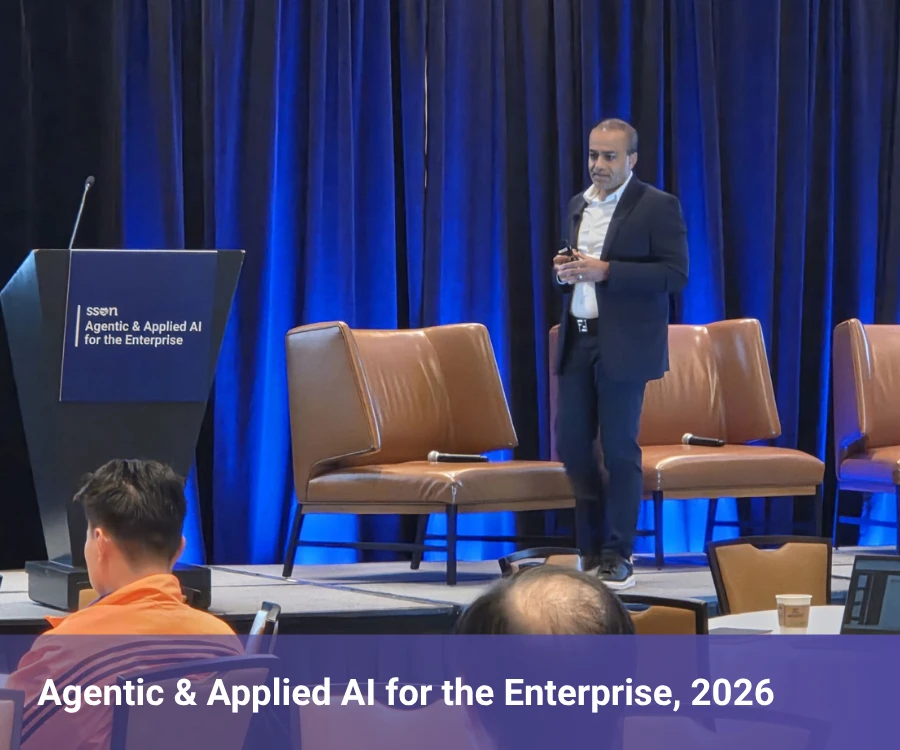
Doing More with Less: The Case for Agentic AI
At SSON's Agentic & Applied AI for the Enterprise conference, discussions reflected the shared services/ Global Business Services' (GBS) desire to answer structural questions that limit agentic adoption:
- How should shared services design processes for AI agents?
- How should agentic workflows be governed?
- How should teams measure the output of agentic AI?
In his keynote, Architecting the Future: Unlocking a Strategic Mindset in the Age of AI Agents, Sharad Aggarwal, highlighted the "2026 capacity paradox" – as workloads increase while budgets and headcounts remain flat or decline.
This familiar pressure to "do more with less" makes answering these structural questions critical to unlocking the potential of agentic AI as a competitive advantage. For Sharad, the shift to agentic AI "is not just an IT problem; it is a journey. It is a strategic and operational crisis."
The Problem with Pilot Purgatory
Despite the transformative potential of AI agents, many are stuck in "pilot purgatory." Sharad began by asking, "How do you move these small pilots to a real enterprise scale? Moving from the press release to the balance sheet – how do you achieve those savings?"
The scaling challenge arises from what Sharad identifies as FOBO – or the fear of being obsolete. With the current hype around AI, organizations are keen to deploy agents and avoid being left behind in the agentic age. However, this means teams are prioritizing speed over identifying the most strategic use cases. These projects often generate excitement, internal press, and proof-of-concept momentum, but they do not translate into measurable business value.
The result? "Pilots are sitting like graveyards," Sharad notes.
The 3G Model for Agentic Deployment
This lack of discipline around use case selection often means organizations are not laying the foundations required for agentic AI at scale. In the race to experiment, critical issues such as data readiness, governance frameworks, and business ownership are often left unresolved.
This is where shared services leaders must be especially careful. Not every workflow is AI-ready. Not every process should be disrupted immediately. The priority should be to identify workflows where the architecture and ROI potential are strong enough to support agentic transformation.
As a solution, Sharad outlined the 3G model:
The 3G Model
- Grounding: Many business processes still depend on tribal knowledge that exists in employees' heads rather than documented systems. If that knowledge is not captured and connected, agents will struggle to deliver reliable outcomes.
- Guardrails: Boundaries determine how much autonomy an agent has, when it must escalate to a human, and which data it can access. Without these safeguards, organizations risk creating agents that are technically capable but operationally unsafe.
- Governance: Organizations must establish clear accountability for agent performance and decision-making. Who owns the agent? Who is responsible for onboarding and monitoring it? How are outputs audited? And who is accountable when an agent produces an inaccurate or non-compliant outcome?
The Death of FTE-Based Thinking
For decades, shared services performance has often been tied to efficiency metrics such as cost per transaction, headcount reduction, speed, quality, and labor arbitrage. These metrics still matter, but they are insufficient for the agentic era. Importantly, this is a conversation about how success is measured, not a conversation about headcount — Sharad was clear that AI adoption and workforce decisions are separate discussions, and conflating the two risks missing the point entirely.
Sharad challenged the continued reliance on FTE-based models, arguing that they fail to reflect how work is changing. If AI reduces manual effort but organizations continue measuring success primarily through headcount reduction or labor savings, they risk optimizing for the wrong outcomes. Sharad highlighted that teams should not "look at agents as an automation piece, look at them as digital workers."
As such, agentic enterprises need to move towards outcome-based measurement. Success should be defined by factors such as:
- Contextual accuracy
- Latency
- Token efficiency
- Continuous verification
- Business outcomes
- Effectiveness of human-AI collaboration
Creating a Culture of Co-Creation
The agentic enterprise requires a culture of co-creation – where business, IT, operations, risk, and frontline teams are brought into the transformation journey from the start.
For Sharad, this is one of the defining characteristics of organizations that will succeed in the agentic era. Agentic AI should not be approached with a "know-it-all" mindset, where solutions are designed centrally and pushed into the business. Instead, "It is a team sport." That means:
- Defining shared success criteria from the outset
- Aligning teams around phased deployment
- Measuring whether AI is truly embedded into workflows
Leaders need to bring people together through a shared understanding of what AI agents are being asked to do, where human judgment remains essential, and what success should look like across the hybrid workforce.
A culture of co-creation helps reduce resistance. As AI changes the nature of work, employees need to understand that the objective is not to replace human effort, but to redesign where human judgment creates the most value – "AI has not pulled the floor, it has raised the ceiling." When teams are encouraged to see AI as a companion rather than a threat, they can focus less on defending existing tasks and more on improving the quality, speed, and intelligence of the outcomes they deliver.
Final Thoughts: The GBS Agentic Opportunity
For GBS and shared services, agentic AI creates a major opportunity. These functions are uniquely positioned to lead agentic transformation as they already understand the end-to-end workflows. GBS teams have the domain experience alongside the technology expertise.
However, success will depend on moving beyond experimentation and addressing the structural foundations of agentic AI. Organizations must establish trusted data, clear governance, robust guardrails, and measurement frameworks that focus on outcomes rather than headcount reduction alone.
For Sharad, the organizations that will gain the greatest advantage from agentic AI will create the right operating model around them. This means:
- Challenging legacy ways of working
- Prioritizing auditability and defensibility
- Redesigning ROI metrics beyond traditional FTEs
- Viewing agentic AI as an intelligence layer, not an automation layer
- Maintaining robust human oversight with clear governance
- Building a culture of co-creation
GBS leaders need to "stop optimizing the past. Architect the future."
Sharad Aggarwal has spent decades in the tech industry in senior leadership roles across Big Tech. Currently at Google, Sharad Aggarwal leads AI & Engineering Solutions within Google Cloud's global Vendor Management Organization, where he works across core engineering services and enterprise AI deployment at scale. He serves on the Board of Directors for the UCLA Anderson Alumni Network, leading its AI Task Force, and is a frequent keynote speaker and panelist — including a TEDx talk — sharing his personal perspective on AI adoption and the future of work. Connect with him on LinkedIn.
Note: Views shared in this session and article are Sharad's own and do not represent an official position of his Google, Alphabet, current or past employer.