Designing the Future R2R Operating Model: From Fragmented Processes to Intelligent Finance Platforms
Add bookmark

Transformation Is No Longer Enough
The future of Record-to-Report (R2R) will not be shaped by incremental improvement. It will be defined by operating model reinvention.
Over the past decade, finance organizations have standardized R2R processes, centralized operations into GBS, and implemented global ERP platforms. The result has been efficiency, cost reduction, and stronger control.
But the model is now reaching its limits. Fragmentation persists across systems, entities, and regions, and incremental change will not solve structural complexity. R2R needs reinvention over optimization.
The Real Problem: Operating Model Complexity
At scale, R2R operates as an ecosystem of multiple ERPs, local statutory requirements, diverse business models, and regional execution layers. Even mature GBS organizations face inconsistent close processes, misaligned data definitions, limited enterprise visibility, and manual workarounds at scale. Complexity is an operating model issue as much as a system issue.
Why AI Exposes the Breakpoint
AI is accelerating R2R evolution, but it is also exposing structural gaps. In fragmented environments, data is inconsistent, processes are non-standard, controls vary by entity, and insights cannot scale.
AI amplifies what already exists: good or bad. In a global transformation I led across 245 ledgers and 97 countries, process and data standardization was the foundation. Without it, automation did not scale.
Lesson: AI does not fix fragmentation. It magnifies it.
The Shift: From Processes to Platforms
The future of R2R is a connected, intelligent finance platform built beyond process-centric design. This platform integrates standardized global processes, governed and unified data models, embedded controls, and AI-driven automation and insights.
5 Design Principles for Future Record-to-Report
1. Standardization Before Automation
Automation scales chaos without standardization. Focus on global process harmonization, a standard chart of accounts, consistent close calendars, and unified policies and controls. No standardization means no scalable AI.
2. Platform-Centric Architecture
The priority is integration rather than "one ERP." Key elements include a connected ERP and best-of-breed ecosystem, seamless data architecture, and scalable design for acquisitions and growth. The goal is coherent data across systems.
3. Embedded Intelligence
AI must be built into workflows. Examples include smart reconciliations, automated journals with controls, predictive close monitoring, and real-time anomaly detection. Intelligence must be native to the process.
4. Continuous Assurance
Control is shifting from periodic to real-time. Future R2R enables continuous transaction monitoring, automated control execution, built-in audit trails, and real-time risk detection.
5. Business Integration
R2R cannot operate in isolation. Future state enables a direct link between actuals and forecasts, faster decision-ready insights, and a single financial narrative across the enterprise. R2R becomes a decision foundation and moves beyond reporting.
GBS Must Evolve: From Execution to Orchestration
Traditional GBS delivered cost efficiency, process standardization, and transaction execution. That is no longer sufficient. Next-generation GBS must become:
- Process orchestrators
- Data custodians
- AI and automation enablers
- Insight drivers
Talent Shift: From Processing to Decision Support
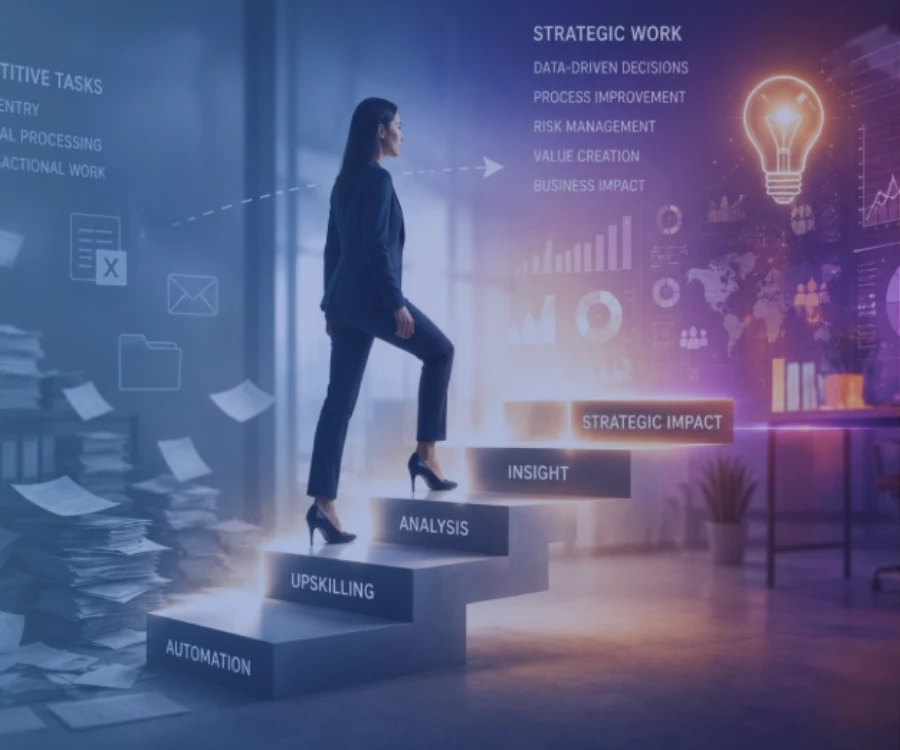
R2R talent is being redefined. Future capability requires accounting and data fluency, AI interpretation skills, strong business judgment, and insight-driven thinking. Routine work is automated; judgment becomes the differentiator.
Path Forward: Practical Reinvention
There is no "big bang" required. Focus on high-impact standardization first, platform-based architecture, embedded automation and AI, continuous control redesign, and capability building in parallel. Progress matters more than perfection.
For CFOs, Controllers, and GBS leaders: stop optimizing fragmented models. Start designing integrated platforms. Align data, technology, and operating model decisions. Elevate GBS into a strategic orchestrator. The future of R2R will be defined by intelligence at scale, beyond efficiency alone.