SSON’s Best Articles of 2025: A Year in Thought Leadership
Add bookmark
As the new year approaches, the GBS industry looks back on 2025 as a year of transformation, defined by AI innovation, evolving talent management priorities, and fresh approaches to GBS value delivery.
Throughout the year, the SSON community collaborated with GBS thought leaders to address key topics, challenges, and emerging developments. This enabled our dedicated pool of contributors to deliver forward-looking perspectives that resonate with the SSON readership consistently.
As such, it seems fitting to highlight the top articles of 2025 and what lessons from them GBS leaders should carry into 2026 and beyond.
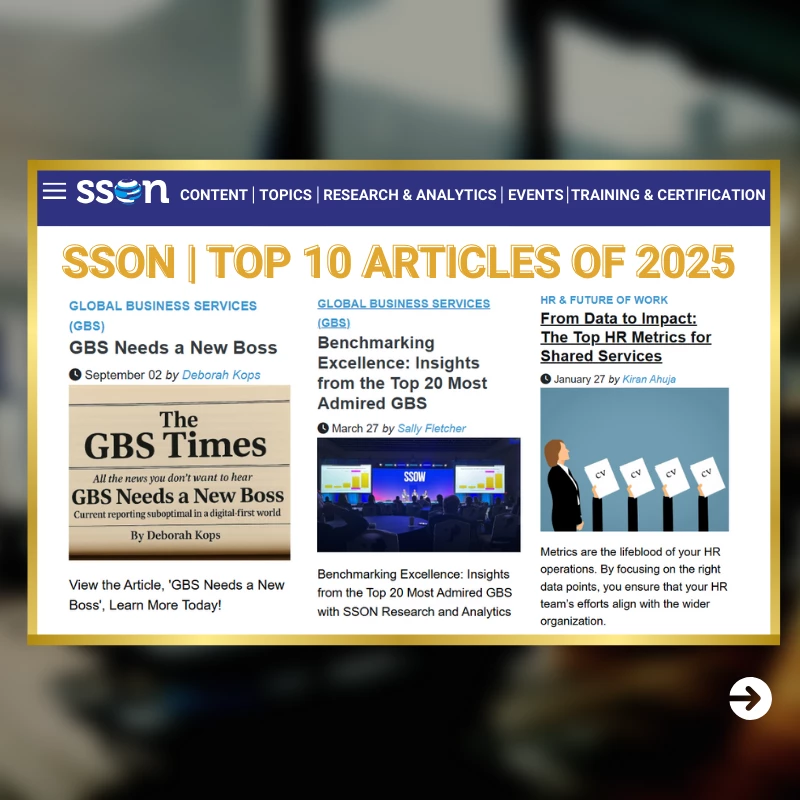
1. From Traditional AI to Agentic AI: Unifying AI, ML, Deep Learning, and Gen AI
In this piece, Ramnath mapped the evolution of AI from basic rule-based systems to the emerging era of agentic AI: autonomous, goal-driven systems that integrate traditional AI, machine learning, deep learning, and generative AI into a unified framework.
The article helps practitioners understand this unfolding agentic landscape, emphasizing how hybrid AI systems can underpin next-gen automation, adaptive learning, and enterprise-wide decision-making.
2. GBS Needs a New Boss
By Deborah Kops
Deborah challenged traditional organizational models by highlighting how many GBS units are constrained under CFO leadership. She made the strategic case for reporting lines better aligned with technology and transformation (for example, under CIOs) to unlock innovation and cross-functional value creation.
3. Benchmarking Excellence: Insights from the Top 20 Most Admired GBS
By Sally Fletcher & Barbara Hodge
At this SSOW Orlando 2025 session, industry leaders explored how the Top 20 Most Admired GBS organizations benchmark themselves. The discussion highlighted three key metrics: attrition, automation, and error rate improvements. Leaders shared how data-driven approaches to employee experience, innovative automation solutions, and continuous quality improvements enable these organizations to retain talent, achieve cost savings, and improve operational performance.
4. GCC vs. GBS
By Deborah Kops
Amid ongoing debates about operational models, Deborah covers GCC (Global Capability Centres) versus GBS, clarifying the differences and strategic implications. Key themes included how GCCs integrate more closely with core business functions and can evolve into strategic hubs, whereas the traditional SSC models focus on transactional efficiency.
5. Building a Modern Shared Services Center: Strategies for Success
Insights from K&B Global
This practical guide, based on K&B Global’s January 2025 webinar, offered leaders a roadmap to build shared services that are future-ready, agile, and digitally enabled. Themes ranged from designing global delivery models to embedding customer-centric operating principles, reinforcing that modern shared services must balance operational excellence with strategic contribution.
6. From Data to Impact: The Top HR Metrics for Shared Services
By Kiran Ahuja
As shared services broadened their scope, this article highlighted the importance of data-driven HR metrics, from talent mobility to employee experience, to quantify impact and guide continuous improvement. By shifting focus from traditional KPIs to outcomes that matter to the business, this piece helped HR leaders reinvent value measurement.
7. AI Agent Protocols: 10 Modern Standards Shaping the Agentic Era
AI agents and agentic systems gained rapid traction in 2025. This article explored protocols and standards that enable interoperability, secure orchestration, and robust agent behaviour, a key primer for organizations looking to operationalize next-gen automation at scale.
8. Are Traditional Techniques Like Kaizen and Lean Six Sigma Still Relevant?
Even as digital transformation accelerates, this reflection on Kaizen and Lean Six Sigma reaffirms the relevance of classic process-improvement methodologies. The piece offered balanced perspectives on how these frameworks continue to complement modern tools like automation and analytics, especially in optimizing workflows and nurturing a culture of excellence.
9. The Five Most Critical Roles for GBS to Drive Value
By Bob Cecil
In this forward-looking piece, Bob Cecil identified the core roles and competencies GBS must cultivate, from business partnering to strategic analytics, to move beyond operational service delivery into true enterprise impact. By reframing GBS as a value-enabling function, this article helps push the industry conversation toward long-term relevance and influence.
10. The Art of Being a True Business Partner
By Misty Thorpe
Closing the year on a people-centric note, this article explored what it means for shared services professionals to transcend traditional back-office roles and become trusted partners to business units. It emphasized communication, trust-building, and outcomes alignment as cornerstones of modern shared services success.
Key Considerations for 2026
As 2025 draws to a close, these thought leadership pieces collectively signal a pivotal moment for GBS. Leaders must balance technology adoption with human-centric strategies, ensuring GBS continues to evolve from a transactional function into a strategic enabler of enterprise value.
- Accelerate Digital Transformation: Harness agentic AI, automation, and data analytics to drive agility and enterprise-wide decision-making.
- Redefine Organizational Models: Align GBS reporting structures and roles with transformation priorities, moving beyond cost-center thinking.
- Prioritize Talent and Culture: Focus on employee experience, outcome-driven HR metrics, and continuous improvement to retain and develop top talent.
- Strengthen Strategic Partnerships: Position GBS as a trusted advisor, embedding business alignment and value creation into every interaction.