How to Build a Change Engine Beyond Communications
Reflections on Enabling Transformation at Merck KGaA, Darmstadt, Germany
Add bookmark
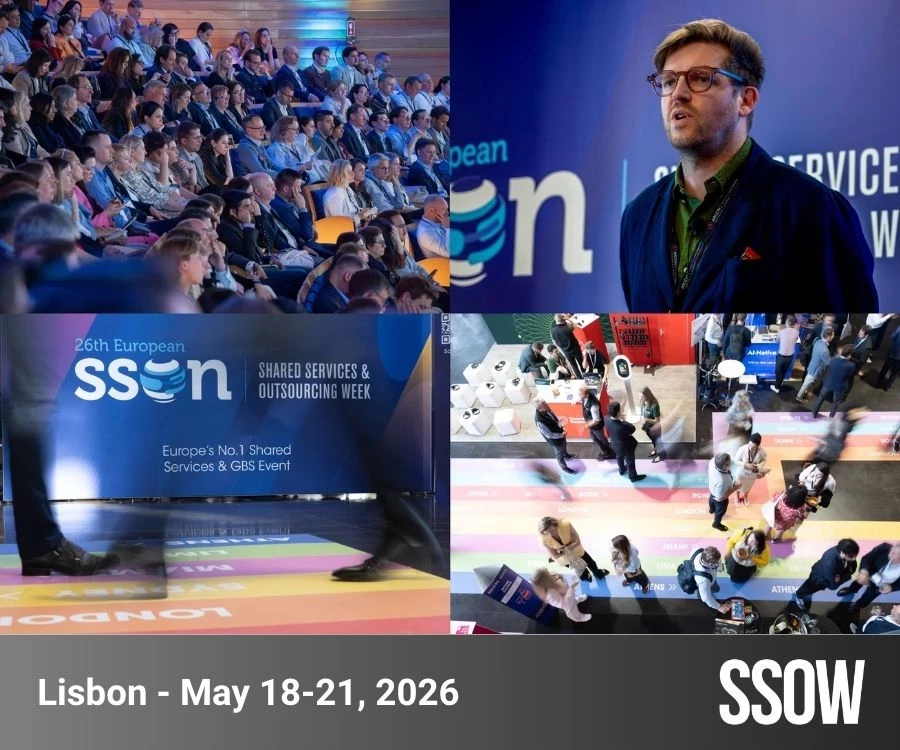
At Shared Services and Outsourcing Week Europe last week, among all the GenAI, agentic workflows, and process excellence talks, there was a smaller but vital presence of experts who focused on the human side of transformation.
Jan Derek Gill, Head of Change Management and Communication at Merck KGaA, Darmstadt, Germany, was one of these experts. He brought with him a series of indispensable lessons from his 10+ years in strategy, transformation, change management, and communication – and close to five years putting it into practice at his current company. The insights that follow are condensed from his practical, informative session on Wednesday, May 20.
Change Just Keeps Changing
"One thing is for certain – the waves of change keep coming," said Gill, referring to the tumultuous waters of today's pace of change. While previously, it was enough to brace for a single wave of change and carefully ride it out as it hit, this change posture won't get you very far anymore. The waves now overlap, collide, and arrive before the last one has receded, leaving organizations in a state of permanent turbulence rather than periodic disruption.
This has consequences for the frameworks change leaders have long relied on. McKinsey's C4 Change Management Framework, a popular playbook for change leaders, talks about climbing the ladder of change. In calmer waters, the logic holds. Gill counters this with: "You don't climb the ladder of change anymore. You run all four floors at the same time."
So, how do you make the impossible possible?
Five Key Elements of Enabling a Successful Transformation
With Merck KGaA, Darmstadt, Germany's transformation continuing to evolve, Gill offers five key learnings:
1. Connect the dots (and reduce noise)
In a transformation spanning multiple geographies, functions, and workstreams simultaneously, no change management team can be a subject matter expert in everything. What the team must do is maintain a clear line of sight across it all.
"We need to know what is happening? What is changing? How does it tie to the bigger picture? How does it tie to our strategy?," said Gill. This requires embedding people with key functions, with clear process ownership, so that the threads between individual initiatives and the broader transformation narrative can always be drawn – and re-drawn as things shift. The communications team needs to ensure the right messages reach the right audiences at the right time, while simultaneously aiming to reduce other noise and irrelevant communications.
2. Re-win hearts and minds constantly
In a multi-year transformation, winning people over is never a one-time event:
"We constantly need to work on making the change desirable – taking them along the journey, speaking in the words of our colleagues."
This means investing continuously in content and campaigns that make change feel meaningful at the individual level, not just rational at the organizational level. Co-created engagement campaigns, real faces, and real success stories from the teams themselves are far more powerful than polished corporate messaging produced centrally.
3. Model the change you ask others to make
One of Gill's sharpest observations was about the responsibility that leaders must take to model behaviors during transformation.
"The community has a very strong awareness and a very sharp eye for how the leadership team models the change. What decisions are being taken? And do they reflect what we communicate?"
Employees notice inconsistency between what is said in town halls and what plays out in practice. Leaders who visibly embody the behaviors they are asking of others are among the most powerful change levers available. Those who don't, on the other hand, undermine every other effort in the engine.
4. Build culture from day one
In the traditional framework, culture and identity sit at the top of the ladder, as the destination after everything else is in place. Gill's experience tells a different story.
"I believe it's something we need to start embedding from day one. We need to talk about behaviors – about what we encourage in terms of culture and mindset – and really focus on it from the beginning."
The norms, behaviors, and identity that will sustain the new organization need to be seeded and modelled from the very start of a transformation, not bolted on at the end.
5. Keep the dialogue alive
Identifying resistance – and tracking how it shifts as the transformation progresses – requires ongoing proximity to the people living through the change. Gill's team uses a deliberate mix of mechanisms, including regular pulse checks, dedicated sessions around specific strategic initiatives, and corporate dialog channels.
The goal is always the same: stay as close as possible to how different teams and functions are actually experiencing the change, so that challenges or resistance can be spotted early, supported, and addressed at the right level.
Everyone attending Gill's talk agreed that change has changed. The question remains: Who do we need to be to deal with this new era of change?
From the Room: Phasing Communications, Building Community, and Measuring Success
The Q&A that followed was frank and practical, surfacing questions that the attendees were keen to get a new perspective on:
Q: What's better – communicating all the change and its associated pains at once, or in stages?
A: On whether to release difficult news all at once or in stages, Gill was honest: "It really depends on the change." But the key principle, whichever approach is taken, is transparency about what comes next." With every new change, the community needs to know: when will I learn more? What can we share now, and what can we not? The security comes with certainty about timing, even if you can't share the whole picture yet."
Q: How do you build community and enable successful change when working with a distributed workforce?
A: On reaching a distributed, remote workforce, the advice was consistent with the broader framework: balance leadership visibility with grassroots authenticity. "Whenever we can, we try to show real faces, real success stories from the teams. Even a small, seemingly trivial moment of progress – connected to the desired behaviors – can travel further than a polished central campaign."
Q: Can you tell us how you measure change management success?
A: On measurement, Gill acknowledged the complexity with an understanding that only a fellow practitioner can embody. Beyond the headline engagement and participation figures, his team tracks whether employees understand and feel connected to the strategic direction, whether they find leadership approachable, and whether specific changes are being adopted as intended, using targeted pre- and post-surveys alongside the annual engagement cycle.
Want to be in the room next time? Register your place at SSOW Autumn this October and you'll get direct access to thought leaders and experts, like Gill, as well as a week of valuable insights and network building. We hope to see you there.