In light of Artificial Intelligence (AI), companies must reconsider their approach to outsourcing. Outsourcing can support AI transformation by lowering costs and boosting business results. Although earlier technologies like ERP software and RPA fit well with established outsourcing methods, AI introduces unique challenges. The recent Research Insights Report from Shared Services and Outsourcing News, "Business Process Outsourcing in 2026: Shifting Expectations," offers an additional viewpoint. This article discusses why a new mindset is necessary and recommends practical adjustments tailored to AI.
Why Re-think Outsourcing with AI?
AI brings both new possibilities and challenges to outsourcing.
- The Potential of General Artificial Intelligence: Predictions about automation replacing human labor have existed for years, but earlier technologies always reached their limits. Historically, over 70% of service delivery costs were tied to labor rather than technology. Previous technologies relied on deterministic logic, while AI operates using probabilistic logic, allowing it to mimic certain aspects of human thought and reasoning. As organizations approach General AI, systems with the ability to learn, understand, and apply knowledge across tasks like humans, the replacement of human workers by AI agents could occur on a far broader scale than with earlier technologies.
- Major Economic Changes: AI lowers service delivery costs and shifts cost structures. Instead of traditional linear models, AI creates non-linear cost dynamics, making service costs less sensitive to volume changes. It also presents increased opportunities to deliver value beyond productivity boosts and cost reductions. For example, using AI effectively in customer-facing roles can enhance both customer acquisition and retention. This will likely affect outsourcing pricing strategies.
- Greater Risks and Complexity: Unlike previous technologies, AI, especially generative AI, relies heavily on an organization’s unique data and processing methods. This enables AI to handle more complex and company-unique processes than outsourcers typically manage. However, these advances also bring greater complexity and increased risk. For example, the probability of success of any individual AI project increases alongside process complexity. Switching providers can be costly if your data and process knowledge are deeply integrated in a company’s AI agent. AI has also demonstrated the risk of creating errors (e.g., hallucinations). These are just a few examples citing the need to rethink outsourcing risk management.
How Should Companies Respond?
AI influences every phase of the outsourcing lifecycle:
- Strategy and Assessment: Decide if outsourcing fits your goals.
- Solutioning and Selection: Choose the right provider and operating model.
- Negotiations and Contracting: Establish agreements for a secure and fair partnership.
- Governance and Relationship Management: Ensure ongoing value meets expectations and needs.
Below are AI-related factors to consider at each phase.
Strategy and Assessment
AI is reshaping traditional perspectives regarding the decision to outsource processes or retain ownership, as well as how outsourcing relationships are structured. Historically, organizations have tended to keep processes in-house when they are critical or unique to business operations, and internal resources can be allocated to ensure optimal performance. Within the context of AI, consider the following:
- Should critical or unique processes remain managed in-house if AI handles most tasks and humans only make the final decision?
- Is outsourcing essential to access specialized talent for AI transformation?
- Are costs too high to bring work back in-house or switch providers due to customized AI being more difficult to decouple from an existing operation?
- How can operational risks like supply chain issues or customer loss be managed when outsourcing complex processes?
- What alternatives to traditional outsourcing, such as Build-Operate-Transfer, should be considered to address AI-related risks?
- Do the benefits of using outsourcing to achieve AI transformation outweigh the risks?
The advent of AI introduces both significant opportunities and heightened risks that must be carefully assessed when determining the appropriate approach to outsourcing.
Solutioning and Selection
AI offers varying degrees of customization:
- Embedded agents: These are pre-built agents that come integrated within Commercial Off the Shelf (COTS) software.
- Standardized agent-as-a-service platforms: Agent builders provide ready-made templates to address common business needs such as hiring or onboarding.
- Configure-to-work agents: These AI agents, created through standard agentic AI platforms, require integration with an organization’s specific data and workflows.
As you use configure-to-work agents in outsourced processes, complexity rises. Consequently, success rates can vary significantly for each AI-enabled process—a trend confirmed by research indicating relatively low rates for individual AI pilot projects. However, broad implementation of AI across multiple areas can yield overall positive outcomes, even if some efforts experience lower success rates.
Traditionally, companies choose outsourcing providers via a competitive Request for Proposal (RFP) process, soliciting bids from three to five candidates. This approach works best for uniform solutions offered by many vendors, such as outsourcing accounts payable or receivable functions. In these cases, improvements typically follow a standard roadmap—moving existing or streamlined processes to cost-effective locations, adopting well-known technologies and best practices, and pursuing continuous enhancements.
The RFP model can fall short when tackling more complex, customized opportunities involving advanced AI. If widespread AI adoption is your goal, you’ll need a new approach with features such as:
- Choosing providers with whom you can have a partnership versus a transactional relationship
- Rapidly narrowing the field to three or fewer (often just two) candidates for deeper exploration
- Using agile methods, releasing details typically developed up-front in an RFP, like scope and pricing, gradually in iterative sprints
- Collaborating on solutions across an expanded portfolio of potential AI-enabled processes
- Testing data portability and other key assumptions before contracting
- Incorporating pilots and development of Minimum Viable Products into your transformation plans
- Designing ongoing governance and relationship management frameworks before selecting a provider and operating model
In contrast to the traditional RFP process, this solution and selection process must be flexible and focused on choosing partners capable of working with you across a variety of opportunities, without rigid transition and transformation paths fully predefined.
Negotiations and Contracting
A traditional outsourcing contract clearly defines service expectations, improvements, risks, and obligations for each party. It usually includes:
- A Master Services Agreement (MSA) and exhibits: The main legal framework covering terms and conditions, as well as common frameworks like service level methodology and commercial models for all outsourced services.
- Process/service supplements and attachments: Documents detailing specifics of each process or service, including scope, service levels, transition and transition plans, pricing, and governance.
Such contracts are generally very prescriptive since the solutions they offer are fairly standardized. By contrast, AI-driven outsourcing requires a unique operating and commercial model to accommodate more variability throughout the transformation lifecycle.
Compared to traditional agreements, an AI-driven outsourcing contract features:
- A modular MSA that allows for different terms (such as service level methodology and pricing) depending on the process’s form and stage of transformation.
- Pricing options based on business outcomes and fixed or subscription rates, acknowledging the non-linear economic nature of AI-enabled processes.
- Term and termination rights focused on maintaining a perpetual versus specific time-limited relationship while providing flexibility to end individual components.
- Provisions specific to AI covering intellectual property, liabilities, restrictions, safeguards, standards, rights to revoke, compliance requirements, use of third-party AI platforms and resources, service remediation, and indemnities.
- Clearly defined governance rights and protocols for investing in innovation and modifying the portfolio of processes undergoing AI transformation.
- Incentives for providers who exceed business outcome targets, rather than just penalties for substandard performance.
- Procedures and tools for managing and auditing AI agents and related resources within the governance framework.
Governance and Relationship Management
Implementing AI at scale necessitates a revised relationship framework between buyers and providers of outsourced services. Rather than an arm's-length approach typical of conventional outsourcing, both parties engage in a vested partnership, as illustrated in the graphic below.
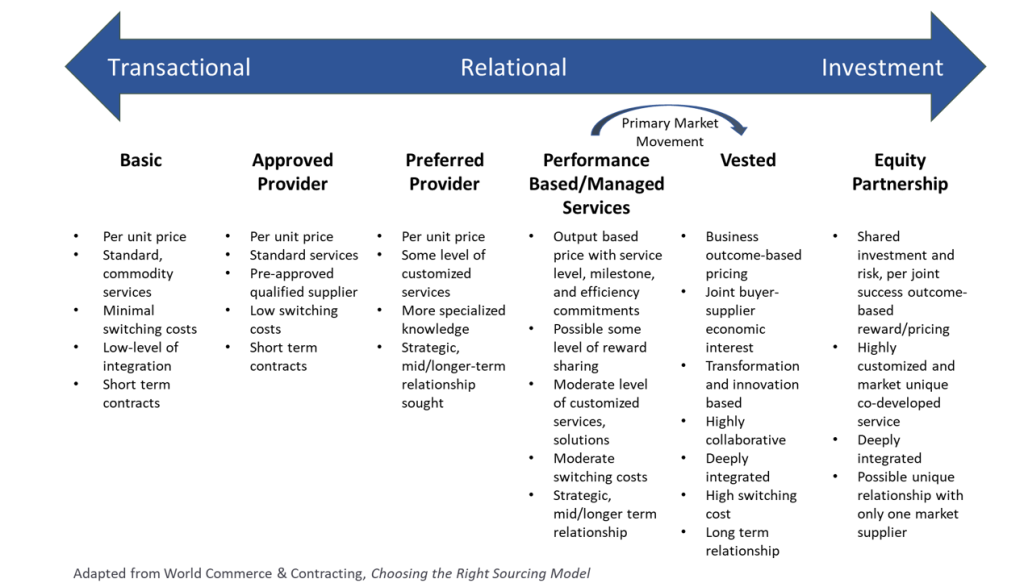
Traditional outsourcing management emphasizes sticking to the contract for a defined set of services. In contrast, vested partnerships prioritize ongoing adjustments to service portfolios and transformation projects to stay aligned with evolving objectives. Instead of relying on a fixed, long-term budget, these partnerships involve continuous forecasting and require greater executive involvement beyond just contract managers or individual service leads. Additionally, at an operational level, AI-driven outsourcing demands close monitoring of both performance and safety of AI systems.
Conclusion
Outsourcing methods are deeply rooted, making change difficult. For now, organizations will use both traditional and AI-enabled outsourcing. Still, those aiming for AI transformation must adopt new approaches.
Continue your GBS journey...
Join 1,200+ shared services and GBS leaders at Shared Services & Outsourcing Week (SSOW) (March 8-11 | Orlando, FL)! Get real stories, benchmarks and playbooks from the community orchestrating the future of enterprise value. View the Event Guide.
Learn More