AI Adoption: Fast Is Easy. Finishing Is a Different Problem
Add bookmark

A note before you read this.
This article is not a framework handed down from a research lab. It is what happens when someone with nearly two decades in and around shared services spends months sitting at the intersection of the best research available, the most honest practitioner conversations, and the daily reality of leading through AI transformation. I built something here that I could not find anywhere else, and I hope it gives you a clearer picture of where you are and what finishing actually requires.
Harry Hogge (Robert Duvall) knew something most AI leaders have not figured out yet.
Standing on the pit wall in the movie Days of Thunder, watching Cole Trickle (Tom Cruise) push the car harder than the setup could handle, he said it plainly.: "Loose is fast, and on the edge, you're out of control."
Speed without control is not a strategy. It is a risk waiting to materialize.
And when Tim Daland (Randy Quaid) cut through all the noise in that garage and asked the only question that mattered – "What is the one thing you absolutely need to do to win a race?" – the answer was not go faster. It was finishing the race.
Most shared services organizations right now have plenty of speed. Adoption dashboards are climbing, license activations are up, and training completion rates are being reported at All Hands meetings. The car is loose and it feels fast. But fast and finished are not the same thing, and in AI transformation, confusing the two is the most expensive mistake a leader can make.
Speed is a technology question, but finishing is a leadership question. Most organizations are spending all their time answering the first one, while the second one goes unasked.
Could Versus Should – The Question Most Organizations Never Ask.
Most AI conversations in shared services start with could. Could we automate this process? Could we deploy an agent here? Could AI handle this workflow? And could almost always has an answer because the technology can do more than most organizations realize.
But could is the wrong starting question. As Nellie Wartoft, CEO of Tigerhall, put it plainly, AI is not a strategy, and "everyone else is doing it" is not a business case. The organizations flooding into AI deployment right now are answering could and calling it strategy. The ones that will finish the race are asking should.
Should is the harder question. Should requires you to understand the business outcome you are pursuing before the technology ever enters the conversation. Should requires you to ask whether the process you are about to automate should exist at all in its current form. Should requires real discipline when the pressure to move fast is coming from every direction at once.
Could is a technology question and should is a leadership question, and the distance between those two is where most AI investment quietly disappears.
Grant Thornton's 2026 AI Impact Survey found that organizations with fully integrated AI are nearly four times more likely to report revenue growth than those still piloting: 58% versus 15%. The difference is not the technology but the discipline behind the deployment. The organizations that integrated successfully asked should before they asked could, while the ones still piloting are stuck in a loop of answering could and wondering why the results are not coming.
Two Axes. One Honest Picture.
Here is the diagnostic problem underneath all of this. Most organizations are measuring AI progress on a single dimension: adoption. They track how many people are using the tools, how often they use them, and what percentage of the workforce has completed training. Those numbers matter, but they are measuring one axis of a two-axis problem.
After months of sitting with the research and the practitioner conversations, I built a framework that I could not find anywhere else. Not because the ideas are entirely new, but because nobody had put these two dimensions together in a single diagnostic.
Dr. Paul Leonardi of UC Santa Barbara, whose work I have followed closely through the Teamraderie AI Adoption research program in partnership with Stanford, describes three stages of work design maturity that organizations move through with AI. Stage one is Substitution, where teams are doing tasks faster with AI, but the work itself has not actually changed. Stage two is Augmentation, where the team is beginning to rethink how work is divided between humans and AI, collaboration patterns are shifting, and the workflow is starting to evolve. Stage three is Recomposition, where work has been fundamentally redesigned around what AI and humans each do best. The outcome of Recomposition is genuinely different rather than just faster, and this is where measurable enterprise value lives.
Jason Averbook describes a parallel progression on the human side. Using AI is the stage where the tool exists in your world but has not yet found its way into your workflow. Adopting AI is where habits are forming and work is genuinely changing. Embodiment is where you cannot imagine working the way you used to, the context switch is gone, and AI and work have become the same thing.
These two frameworks are measuring different things. Leonardi is measuring work design maturity and Averbook is measuring human mindset maturity. What my research kept pointing toward is that you need both axes moving together to finish the race. Putting them together produces a diagnostic that is more honest than any adoption dashboard currently running in shared services.
The Maturity Matrix: Four Quadrants. One Honest Assessment.
Place work design maturity on the horizontal axis and human mindset maturity on the vertical. Every team, every function, and every organization sit somewhere on this grid right now, and most of them do not know where.
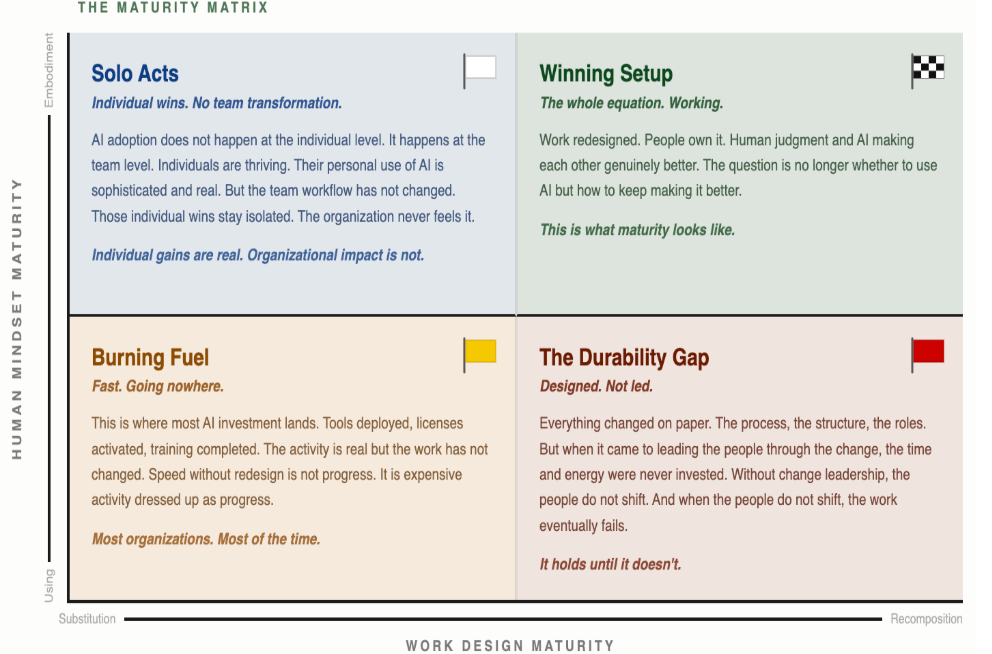
Burning Fuel — Low Work Design, Low Embodiment
Fast. Going nowhere.
This is where most AI investment lands. Tools deployed, licenses activated, training completed. The activity is real, but the work has not changed. AI is being used but the organization is not transforming. Speed without redesign is not progress; it is expensive activity dressed up as progress.
Most organizations. Most of the time.
Solo Acts — Low Work Design, High Embodiment
Individual wins. No team transformation.
AI adoption does not happen at the individual level. It happens at the team level, but here, individuals are thriving. Their personal use of AI is sophisticated and real, however, the team workflow has not changed. Without team level adoption, those individual wins stay isolated. The organization never feels it.
Individual gains are real. Organizational impact is not.
The Durability Gap — High Work Design, Low Embodiment
Designed. Not led.
Everything changed on paper. The process, the structure, the roles. But when it came to leading the people through the change, the time and energy were never invested. Without change leadership, the people do not shift and when the people do not shift, the work eventually fails.
It holds until it doesn't.
Winning Setup — High Work Design, High Embodiment
The whole equation. Working.
Work has been genuinely redesigned around what AI and humans each do best. People have internalized the change rather than simply complied with it. The question is no longer whether to use AI but how to keep making the collaboration between human judgment and AI capability better. This is not a technology story but a leadership story, rare precisely because it requires both axes moving together rather than one chasing the other.
This is what maturity looks like.
Gallup's Q1 2026 research of more than 23,000 employees found that while 50 percent of workers now use AI and nearly two thirds report individual productivity gains, only one in ten strongly agree that AI has transformed how work gets done organizationally. Most organizations are sitting in Burning Fuel or Solo Acts. The Winning Setup is rare, and its rarity is exactly why it is worth building toward.
How to Read Your Own Position.
Before your next AI steering committee or leadership review, ask these questions honestly.
On the work design axis, ask whether the process has been redesigned from first principles or whether AI has simply been layered on top of what already existed. Ask whether roles are being redefined around what humans and AI each do best or whether people are doing the same jobs slightly faster. Ask whether the organization has explicitly asked should we, or whether it has only ever asked could we.
On the human mindset axis, ask whether people are using AI because they are required to or because they genuinely cannot imagine working without it. Ask what happens when the tool is not available and whether work slows down or stops entirely. Ask whether people are proactively expanding how they use AI or whether they are waiting to be told.
Where those two sets of honest answers intersect is your quadrant. Not where your dashboard says you are, but where you are – and the distance between those two answers is the work.
Finishing is a Leadership Decision.
The racetrack analogy earns its place here because it is honest about something most AI strategy conversations are not. Finishing is not an accident. It is a setup decision made before the race begins, refined through every lap, and committed to even when going faster feels like the obvious move.
Harry Hogge did not set out to make Cole Trickle faster. He set out to build a driver who could finish the race, which is an entirely different job and the one most shared services leaders have not yet started.
The shared services functions that will define the next decade of this profession are not the ones with the most impressive adoption numbers or the most tools deployed. They are the ones asking should before could, building toward the Winning Setup with the same discipline they apply to service delivery, and willing to name honestly which quadrant they occupy so they can do the design work to move.
Fast is easy. Every organization has figured out fast. Finishing is a different problem, and the ones who solve it will not be defined by their speed. They will be defined by their setup.